Ask an Engineer: 262-377-2434
When a medical OEM designs a machine to manufacture surgical instruments, diagnostic equipment, or implantable device components, the tolerances are not negotiable. The parts those machines produce will enter operating rooms, diagnostic labs, and patient care settings. The spindle at the heart of the machine has to be built to the same standard of discipline that governs everything downstream of it.
Gilman Precision has been building spindles for medically sensitive applications for decades. Our work has included spindles for orthopaedic bone saw equipment, blood centrifuge manufacturing systems, and a range of high-precision medical production machinery where material traceability, controlled assembly, and geometric stability are not optional features — they are baseline requirements.
This article outlines what differentiates custom spindle manufacturing for regulated medical environments from general-purpose industrial spindle production, and what medical OEMs and machine builders should evaluate when specifying a spindle supplier.
A precision spindle, or bearing assembly, does not carry a regulatory classification. It is a machine component, not a medical device. But the machines it powers — and the dimensional accuracy those machines deliver — exist within a tightly controlled production ecosystem. That relationship matters.
Medical equipment manufacturers routinely machine high-strength stainless alloys, titanium, cobalt-chrome, and advanced engineering polymers to tolerances measured in microns. A spindle that drifts thermally, exhibits inconsistent runout, or introduces vibration into the cutting process can compromise dimensional accuracy across an entire production batch. In a regulated environment, that is not a process deviation that gets corrected at final inspection. It propagates back into your quality system, your validation documentation, and potentially your customer relationships.
The discipline required of a spindle in this context therefore goes beyond rotational accuracy. It includes thermal stability across extended production cycles, vibration control at operating speed, assembly cleanliness, material traceability, and documented quality processes that can withstand an audit.
Micron-level tolerances begin at the spindle — not at the part. If the spindle shaft has geometry errors, if bearing seats are ground outside of tolerance, or if taper integrity is compromised, those errors transfer directly to every component the spindle touches.
Gilman’s spindle manufacturing process addresses geometric accuracy at each stage of production. Shaft cylindricity and roundness are controlled through precision OD grinding in a temperature-stabilized environment. Bearing bores are finish-ground to precise fits in our jig boring machine. Taper geometry is verified against calibrated standards. Axial and radial alignment is measured and documented as part of the release process, not as an afterthought.
|
► Gilman’s spindle clean room and grinding area are held to ±1°F temperature control — because a part measured today must be the same size tomorrow. That thermal discipline is what makes micron-level fits repeatable. |
For medical OEM applications, this level of process control is not a premium option. It is the starting point. Assembly fits that are consistent today and next year determine whether your production process stays in control across its validated lifecycle.
Surface finish is not solely a function of tooling and feeds-and-speeds. A CNC machine spindle that introduces vibration — whether from bearing defects, imbalance, or inadequate preload — will produce inconsistent finish regardless of how well the rest of the process is controlled. In medical equipment manufacturing, where surface finish specifications on surgical instruments, implant components, and diagnostic hardware carry clinical implications, that inconsistency is unacceptable.
Dynamic balancing is a standard step in Gilman’s manufacturing process for all precision spindles. Rotating assemblies are balanced to minimize residual imbalance across the operating speed range. Bearing selection and preload are specified to the application, not selected from a default catalog. Housing rigidity is engineered to provide stable support under the load and speed conditions the spindle will see in service.
For high speed spindle applications — fine-feature machining, finishing of complex geometries, multi-axis contouring of small-diameter medical components — these controls become more, not less, critical as speed increases. Small geometric irregularities that are inconsequential at 5,000 RPM can generate significant vibration at 20,000 RPM. Rotational testing and vibration measurement prior to shipment are part of how Gilman validates spindle performance before it reaches your machine.
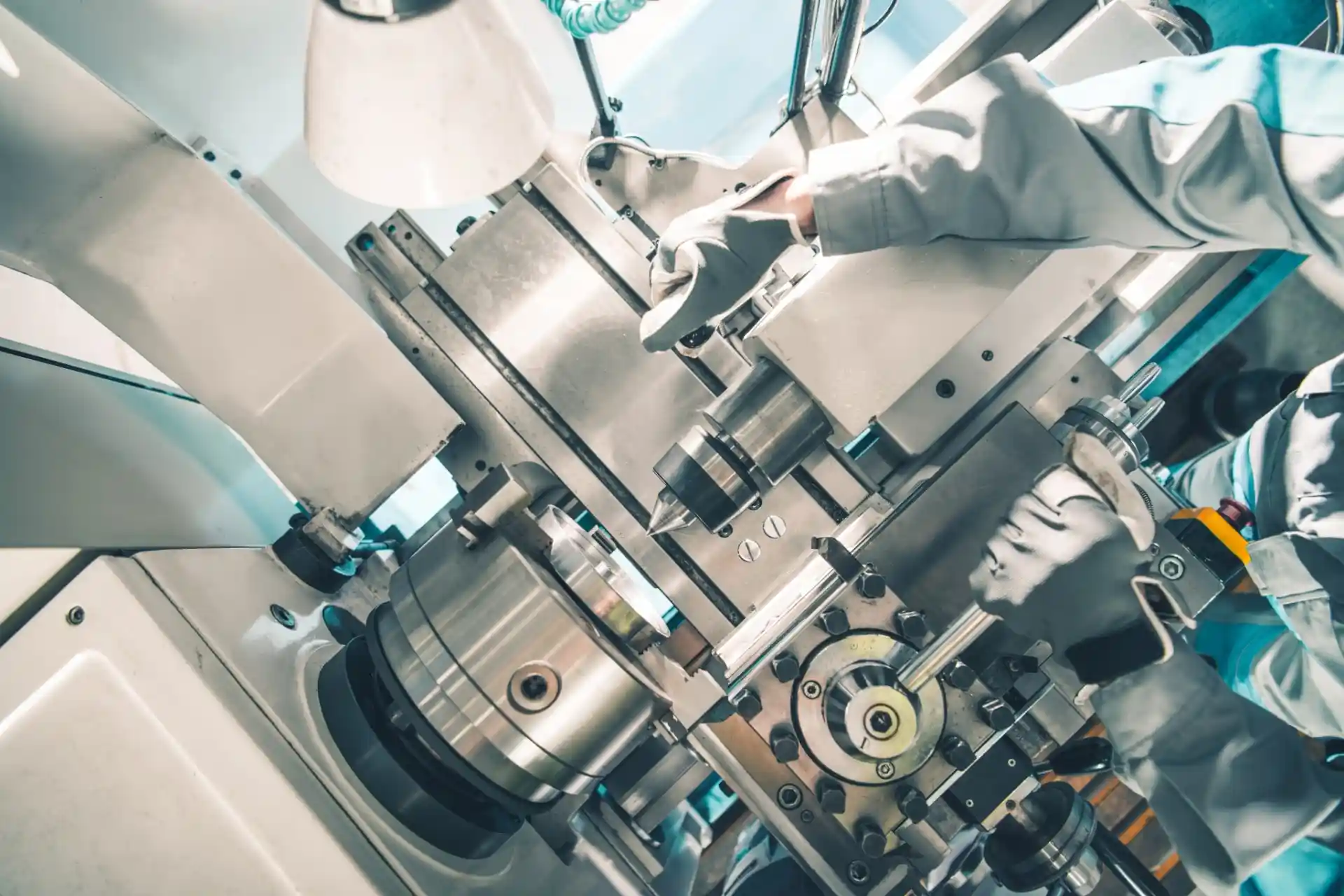
Medical equipment applications often impose material and environmental constraints that general-purpose industrial spindles are simply not designed to meet. Gilman’s experience with medically sensitive applications spans a range of these requirements.
For bonesaw spindle applications, Gilman has built stainless steel spindle assemblies with precision angular contact bearings, food-grade synthetic grease, and specialized seals on the nose end designed to withstand bleach water washdowns. Titanium nitride (TiN) coating on the spindle nose provides additional corrosion resistance and wear protection in environments where chemical cleaning is routine. Tooling interfaces such as ISO 20 tapers with automatic tool change capability are integrated as part of the application-specific design — not retrofitted after the fact.
Assembly cleanliness is managed in Gilman’s dedicated spindle clean room. Documented cleaning procedures, sealing integrity verification, and controlled lubrication protocols are standard elements of the assembly process — not special requests. Contamination inside a precision spindle damages bearings and shortens service life. In a regulated production environment, it also introduces a potential quality event. Gilman’s assembly environment is designed to prevent that at the source.
A spindle that performs to specification at delivery is necessary. A spindle whose materials, assembly procedures, and test results can be verified months or years later is what regulated environments require.
Gilman’s ISO 9001:2015 certification is the framework, but the substance is in the documentation practices: material traceability by serial number, calibrated inspection records, process documentation that travels with the assembly, and retention of quality records that support audit readiness. For medical OEMs operating under FDA quality system regulations or ISO 13485 frameworks, a spindle supplier whose quality documentation integrates cleanly with your own is not a convenience — it is a supply chain requirement.
The practical implication is straightforward. When your process requires a spindle rebuild or replacement and your production line carries a validation history, you need a rebuild partner who can document that the rebuilt spindle meets the same specifications as the original. Gilman’s rebuild and repair processes include the documentation continuity that makes that possible.
|
Evaluating spindle suppliers for a regulated production environment? Contact Gilman Precision to discuss your documentation requirements, quality system alignment, and application specifications. |
General-purpose catalog spindles are designed for the middle of the application range. Medical OEM applications rarely live there.
Custom spindle engineering for medical equipment production addresses the specifics of your machine design: mounting geometries that fit your design, speed and torque curves matched to your material and cycle time requirements, thermal stability targets aligned with your tolerance, and environmental sealing appropriate for your production conditions. Where motorized spindle (integral motor) designs are needed to meet space constraints or dynamic performance requirements, Gilman engineers those configurations. Where belt-driven external drive systems offer better serviceability for your maintenance model, that architecture is available and supported.
|
The difference between a custom-engineered spindle and a catalog adaptation is not cosmetic. It is the difference between a spindle designed for your application and one that requires your application to accommodate its limitations. In medical equipment manufacturing, the latter is rarely an acceptable design strategy. |
Unplanned spindle downtime in a regulated production environment carries costs that extend well beyond the repair itself. A production stop can trigger a non-conformance event, require re-validation of process parameters, and introduce risk into a supply chain with very little tolerance for disruption. Planned maintenance and rebuild strategies are how medical equipment manufacturers protect against that scenario.
Gilman’s spindle repair and rebuild program covers both Gilman-manufactured spindles and units from other OEM brands. Inspection, precision grinding, bearing replacement, dynamic balance verification, and full documentation of the rebuild process are included. For facilities that require spindle motor repair on integral motor designs, that capability is part of the service portfolio.
The goal is not simply to return a spindle to operation. It is to restore it to documented specification — with the records to demonstrate it — so your production process resumes under validated conditions.
Medical equipment manufacturing requires spindle systems that deliver measurable geometric accuracy, documented quality processes, application-specific material and environmental specifications, and lifecycle support that preserves validation continuity. That is a different requirement set than general industrial spindle production, and it requires a supplier who has actually built spindles for those environments — not one who has adapted a general-purpose product to approximate the requirement.
Gilman Precision has been that supplier for decades, across orthopedic, diagnostic, and medical production equipment applications. Our 70-plus years of domestic spindle manufacturing, ISO 9001:2015 quality system, temperature-controlled production facility in Grafton, Wisconsin, and direct engineering engagement from specification through lifecycle support give medical OEMs and machine builders a partner with the depth to get the application right the first time.
| Contact Gilman Precision to discuss your medical equipment spindle application — design, custom engineering, rebuild, and repair support for regulated production environments. |