Ask an Engineer: 262-377-2434
Industrial robotics has expanded beyond material handling into precision machining, trimming, and finishing. The International Federation of Robotics reports that the number of industrial robot installations worldwide and in manufacturing is still on the rise, with growth in metal processing and advanced production cells. With the transfer of machining functions to automated systems, the CNC milling spindle is an important factor in accuracy, repeatability, and surface integrity.
CNC milling spindles for robotics and CNC milling spindles for automation systems must operate within dynamic, articulated platforms rather than rigid cast-iron machine frames. This shift introduces new integration, alignment, and vibration challenges that demand careful engineering evaluation.
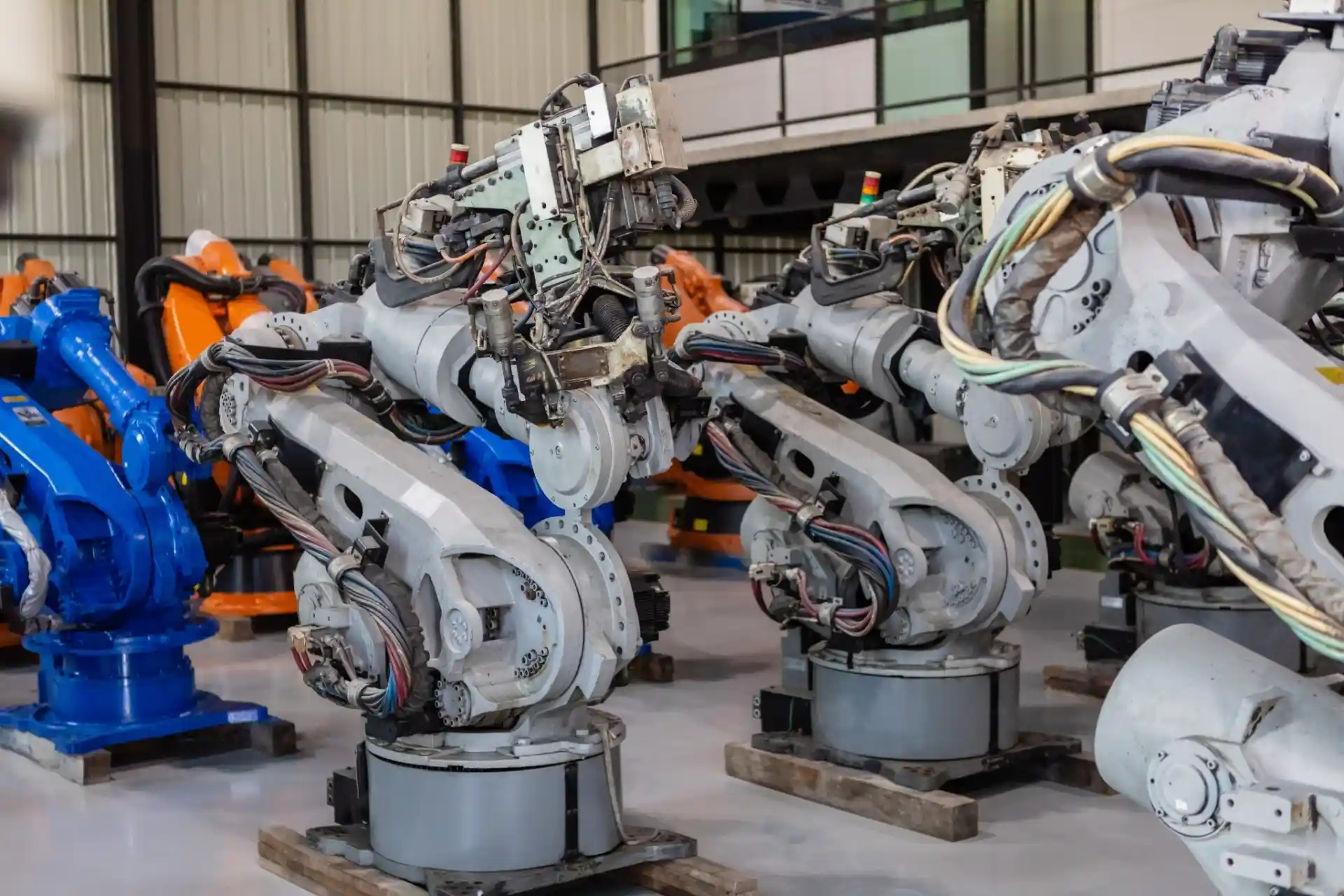
In traditional machining centres, a CNC milling machine spindle is clamped in place using a rigid frame that is intended to absorb cutting forces and reduce vibration. Robotic platforms, on the contrary, are based on articulated joints and service-driven axes. This structural flexibility changes how loads are transferred during machining.
Successful robotic spindle integration requires evaluation of:
The robotics spindle solutions should be designed to work within this range of constraints. Excess spindle weight or insufficient structural support can introduce deflection that affects toolpath accuracy.
A precision spindle selected for robotic use must therefore align not only with machining parameters, but also with the robot’s kinematic and structural characteristics.
In automated machining cells, alignment between the spindle axis and motion control systems directly affects dimensional accuracy.
Critical alignment factors include:
Where automation systems incorporate linear axes or gantry platforms, components such as dovetail slide assemblies must maintain flatness and parallelism across travel lengths. Misalignment in a slide dovetail mechanism can propagate cumulative positioning errors, especially in extended automated cycles.
Maintaining precise geometric relationships is essential for predictable machining results within robotics-driven manufacturing cells.
Vibration management in robotic machining differs from conventional CNC platforms. Articulated arms introduce compliance, and servo-driven motion may amplify dynamic effects at certain speeds.
Research in high-speed machining consistently identifies imbalance and misalignment as key contributors to surface finish variation. In robotic systems, these effects can be magnified due to reduced structural damping.
CNC milling spindles for robotics must incorporate:
Grinding spindle systems used in automated finishing operations require even tighter vibration control. Minor amplitude variation can affect surface integrity and dimensional consistency.
Effective robotics spindle solutions account for both mechanical spindle characteristics and robot structural behavior.
Automation integrators often compare CNC router spindles with high-precision CNC milling spindles when designing robotic cells. Although both are rotating cutting systems, their engineering intent differs significantly.
CNC router spindles are generally optimized for:
They are frequently used in robotic trimming and routing operations where rigidity demands are moderate.
A CNC milling spindle used in robotics applications typically supports:
For metal machining or tight-tolerance applications within automated cells, a CNC milling machine spindle provides greater structural integrity than most router-class systems.
Selection should be based on material properties, required tolerance levels, and dynamic load profiles.
Automated machining cells often operate continuously with limited operator intervention. Precision must therefore be repeatable over extended cycles.
Key performance requirements include:
As automation increases, even a small geometric drift can impact batch consistency. A precision spindle must maintain stability across varying speeds and orientations, particularly when mounted to articulated robotic systems.
In robotic grinding applications, the grinding spindle must maintain concentricity while being synchronized with the motion program. Surface finish quality depends on coordinated motion and stable spindle geometry.
Advanced automation systems frequently combine robotic arms with linear axes or gantry structures. Integrating CNC milling spindles for automation systems within hybrid platforms introduces additional alignment variables.
Engineers must evaluate:
Slide dovetail components that are used in custom fixtures are to be ground and aligned so that cumulative deviation does not occur. It is also important to guarantee that spindle axis stability equals the accuracy of the motion system for predictable automated machining.
Choosing CNC milling spindles for robotics involves more than reviewing RPM ratings. Evaluation should include:
According to industry data, rotating system instability has always been one of the primary reasons for unplanned downtime in automated manufacturing. The right robotics spindle solution allows less risk and better repeatability in the long-term.
At Gilman Precision, engineering-led spindle design, inspection, and rebuild processes support CNC milling spindles for robotics and advanced automation systems. From high-precision milling spindles to grinding spindle integration, disciplined geometric control and vibration management form the foundation of reliable automated machining.
If you are evaluating CNC milling spindles for automation systems or planning robotic spindle integration, contact Gilman Precision to discuss load profiles, motion alignment requirements, and integration parameters. Selecting a spindle engineered for robotics environments supports stable performance, predictable accuracy, and sustained automation reliability.