Ask an Engineer: 262-377-2434
Almost every milling machine ever built starts from the same assumption: the machine stays put and the part comes to it. Bolt the base to the floor, mass is your friend. More iron means more stiffness, better damping, and a better finish.
Flip that assumption and the whole design problem changes. When an OEM came to Gilman building a portable milling machine — a machine that travels to the workpiece instead of the other way around — every pound in the assembly became a design constraint. And the spindle is one of the heaviest single components in the machine.
The engineering question was straightforward to ask and much harder to answer: how do you take significant weight out of a spindle without taking service life out with it?
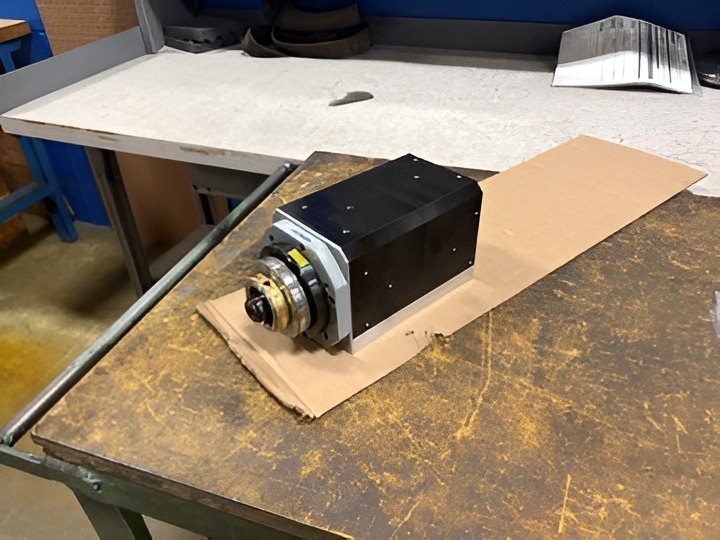
Conventional machine tool spindles are housed in cast iron or steel, and for good reason. The housing does more than hold parts together, it is the structure that locates the bearings and holds them in position under load, heat, and vibration. Iron is stiff, dimensionally stable, and hard enough to give bearing outer races a seat that will not wear.
It is also heavy. On a portable machine, that weight works against the entire premise of the product. A machine an operator has to rig and crane into position is a different — and much less attractive — product than one a two-person crew can set and level themselves.
The obvious substitution is aluminum. It is roughly a third the weight of cast iron for the same volume, it machines quickly, and it sheds heat well. But swapping the material introduces a new failure mode rather than solving the problem outright.
Aluminum is a softer, more thermally active material. Maintaining a stable bearing fit across load and thermal cycles requires careful design. Changes in fit can affect bearing preload, runout, and ultimately bearing life. On equipment intended for field use, reducing that risk was an important design objective.
There was one more constraint. This was a first-article prototype for a machine program the customer intends to scale. Prototypes get scrutinized. Whatever went into this unit had to be right the first time and had to be repeatable in production quantities later.
Rather than choosing between light and durable, Gilman engineers designed a housing that does both jobs with the right material in each place.
A hybrid housing is only as good as the accuracy of the bearing seats inside it, and that is a manufacturing problem as much as a design one. It is also the reason this approach is difficult for a catalog supplier to replicate on a one-off prototype.
Critical bearing-carrier features are precision machined and verified with air gauging before the spindle is assembled. Design, machining, grinding, assembly, and testing all happen under one roof in Grafton, Wisconsin, giving Gilman direct control of the critical features from engineering through final verification.
Engineering Highlights
Gilman delivered a purpose-built spindle that meets the portable machine’s weight budget without accepting the shortened bearing life that a straight aluminum housing would have carried with it. The customer has the first unit integrated into their prototype machine, with additional units anticipated as the program moves forward.
For the OEM’s design engineer, the practical outcome is that a weight constraint stopped being a compromise. They did not have to choose between a machine light enough to be portable and a spindle robust enough to survive in the field — and they did not have to design the housing themselves to get there.
This project is a good example of the kind of work Gilman has been doing since 1951. It is not a catalog spindle with an option box checked. It started as a conversation between the customer’s engineers and Gilman’s engineers about a constraint no standard product solved, and it ended with a purpose-built unit.
Gilman is still designing, building, grinding, assembling, and repairing spindles and slide systems in Grafton, Wisconsin, more than seven decades on, fully domestic and vertically integrated under one roof. When an application does not fit anything in a catalog, that is usually the point at which the phone rings.
If you are working through a spindle problem that standard products do not solve: weight, envelope, speed, environment, duty cycle, or all of them at once, Gilman engineers will work the application with you, including sending you a 3D model early so you can drop it into your design and keep moving.
Have a custom spindle application in mind? Talk it through with a Gilman engineer.
Call 262-377-2434 | Request a quote at gilmanprecision.com